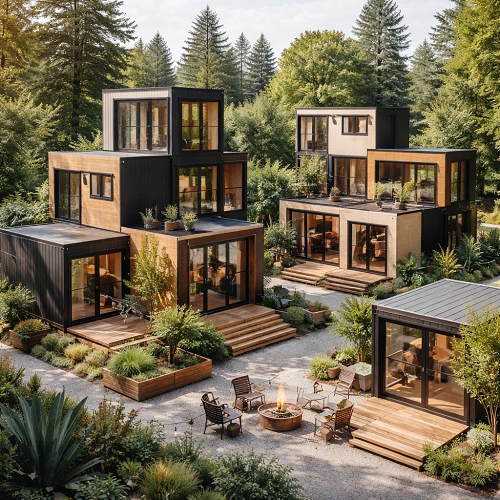
Tiny Houses Modular represents the convergence of compact living, industrialized construction, and systems engineering. Rather than treating a tiny house as a bespoke, one-off build, modularization reframes it as a repeatable product platform—optimized for performance, compliance, transport, and lifecycle efficiency.
1. Modular Architecture: Platform Thinking at Small Scale
At the core of Tiny Houses Modular is platform-based design. Homes are composed of standardized volumetric modules or panelized assemblies that can be configured into multiple layouts.
Key architectural principles:
- Dimensional grids: Modules often follow transport-driven constraints (e.g., 8.5–10 ft wide, 20–40 ft long).
- Inter-module tolerances: Precision manufacturing demands tight tolerances (±3–6 mm) to ensure air, vapor, and structural continuity.
- Service zones: Wet walls and mechanical chases are stacked or aligned across modules to simplify hookups.
This approach enables mass customization—many layouts from a small set of engineered parts.
2. Structural Systems & Load Engineering
Despite their size, modular tiny houses must meet the same structural rigor as full-scale buildings.
Structural frameworks
- Cold-formed steel (CFS): High strength-to-weight ratio, dimensional stability, non-combustibility.
- Engineered wood (LVL, CLT-lite panels): Renewable, excellent thermal performance, requires moisture control.
- Hybrid frames: Steel chassis with timber superstructure for transportable units.
Load cases engineers must solve:
- Transport loads: Dynamic vibration, torsion, wind uplift during highway travel.
- Stacking loads: For multi-module or two-story configurations.
- Point loads: Concentrated forces from lofts, stair systems, and rooftop equipment.
Finite Element Analysis (FEA) is increasingly used to validate designs before production.
3. Building Envelope & Thermal Performance
In tiny houses, every square inch of the envelope matters.
High-performance wall assemblies
- Continuous insulation: Exterior rigid insulation (PIR, EPS, mineral wool) to eliminate thermal bridging.
- Advanced framing: 24” o.c. spacing, optimized headers, reduced studs.
- Airtightness targets: ≤1.0 ACH50 is achievable in factory-built modules.
Moisture management
- Vapor control layers: Climate-specific vapor retarders to prevent interstitial condensation.
- Rain-screen façades: Especially critical in compact assemblies with limited drying potential.
The result: lower HVAC loads and improved indoor comfort year-round.
4. Mechanical, Electrical & Plumbing (MEP) Integration
Mechanical systems
- Ductless mini-splits: High efficiency, small footprint, zoning-friendly.
- ERV/HRV units: Essential for indoor air quality in airtight envelopes.
- Hydronic floor heating (select cases): Efficient but requires careful freeze protection.
Plumbing strategies
- Central manifolds: Reduce joints and leak risk.
- PEX systems: Flexible, freeze-resistant, ideal for transportable structures.
- Greywater readiness: Pre-plumbed for future regulatory acceptance.
Electrical systems
- Load calculation optimization: Smaller panels (100–125A) with smart load management.
- DC-ready pathways: For battery storage and solar integration.
- Factory-installed conduits: Minimize site labor and inspection delays.
5. Energy Systems & Off-Grid Readiness
Tiny Houses Modular excels in energy density—maximizing output from minimal systems.
Energy features include:
- Rooftop or ground-mounted PV (3–8 kW typical)
- Lithium battery banks with modular expansion
- High-SEER appliances and induction cooking
- Smart energy management systems (EMS)
Off-grid configurations require careful coordination between insulation levels, occupant behavior, and storage capacity.
6. Manufacturing Workflow & Quality Control
Factory production transforms construction into an industrial process.
Production stages
- Digital twin modeling (BIM): Clash detection and sequencing.
- CNC fabrication: Panels, frames, and cabinetry cut with millimeter accuracy.
- Assembly line construction: Parallel trades increase speed and consistency.
- Commissioning: Pressure testing, electrical testing, and system calibration.
Quality advantages
- Controlled environment (no weather delays)
- Repeatable inspection protocols
- Reduced material waste (often 30–50% less than site builds)
7. Transport, Foundations & Site Integration
Transport considerations
- Oversize load regulations
- Lifting points engineered into frames
- Shock isolation for finishes and equipment
Foundation options
- Helical piles (minimal disturbance)
- Precast piers
- Slab-on-grade with module anchoring
Connection details—structural, mechanical, and envelope—must be engineered for rapid, error-proof installation.
8. Codes, Zoning & Compliance Strategy
One of the most complex aspects of Tiny Houses Modular is regulatory navigation.
Common compliance paths:
- IRC-compliant modular homes (permanent foundations)
- ANSI/RVIA standards (wheeled units)
- State modular programs with factory certification
Successful projects integrate code analysis early, influencing dimensions, egress, fire separation, and accessibility.
9. Lifecycle, Durability & Sustainability
Modular tiny houses are increasingly evaluated over a full lifecycle:
- Design for disassembly: Modules can be relocated or reconfigured.
- Material transparency: Low-VOC finishes, FSC-certified wood, recyclable steel.
- Long-term serviceability: Accessible systems reduce maintenance costs.
Durability is not optional—compact homes experience higher wear per square foot.
Tiny Houses Modular is not just about living smaller—it’s about building smarter. By combining industrial precision, advanced building science, and scalable design logic, modular tiny houses offer a technically robust solution to housing affordability, sustainability, and adaptability. As regulations evolve and manufacturing technology advances, modular tiny housing is poised to move from niche to mainstream—one well-engineered module at a time.