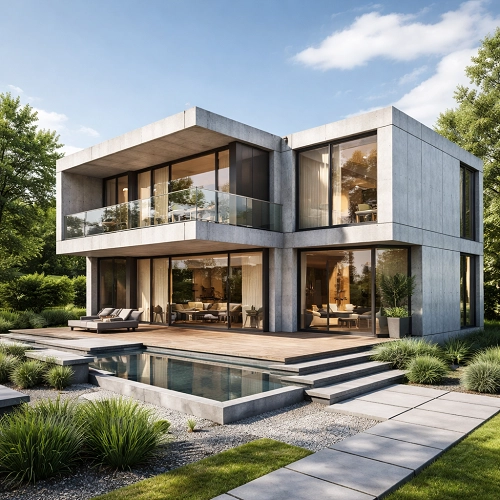
The evolution of construction technologies has significantly influenced how we design and build homes. One of the most transformative innovations in residential construction is the rise of modular housing, and within this sphere, concrete modular houses stand out for their durability, versatility, and sustainability.
What Are Concrete Modular Houses?
Concrete modular houses are residential structures built using precast concrete modules manufactured off-site in controlled factory environments. These modules are then transported to the building site and assembled into a complete structure. Each module typically represents a room or a section of the house, complete with walls, floors, ceilings, and sometimes integrated mechanical, electrical, and plumbing systems (MEP).
Unlike traditional on-site construction, which is labor-intensive and time-consuming, concrete modular construction leverages factory precision, repeatable processes, and standardized components to deliver faster, more consistent results.
Construction Process of Concrete Modular Houses
The construction of a concrete modular house involves several critical stages:
1. Design and Engineering
- Modular design requires careful planning and structural engineering to ensure modules can be stacked, joined, and supported efficiently.
- Architects and engineers use Building Information Modeling (BIM) to design modules with precise dimensions, load calculations, and integration of utilities.
- Structural design must account for dead loads, live loads, and lateral forces (wind or seismic activity) since modules must be self-supporting during transportation and installation.
2. Module Fabrication
- Modules are cast in controlled factory environments, which allows for consistent quality, reduced waste, and precise tolerances.
Concrete mixes are carefully engineered depending on requirements:
High-strength reinforced concrete (typically 30–50 MPa) for load-bearing walls and floors.
Lightweight concrete with aggregates like expanded clay or perlite for insulation and reduced weight.
- Reinforcement is usually provided via steel rebar or mesh, ensuring structural integrity and seismic resistance.
3. Integration of Systems
- Plumbing, electrical conduits, HVAC ducting, and sometimes even kitchen and bathroom fixtures are pre-installed within the modules.
- Pre-installation minimizes on-site work, improves quality control, and accelerates construction timelines.
4. Transportation and Site Preparation
- Modules are transported using flatbed trucks or cranes, requiring careful handling to prevent structural damage.
- The building site is prepared with a foundation system—often a concrete slab or pile foundation—designed to support the modular load.
5. Assembly and Connection
- Modules are lifted into place with cranes and connected using bolts, welding, or post-tensioning methods.
- Joints are sealed with structural adhesives, water-resistant membranes, or grout to ensure structural continuity, air-tightness, and waterproofing.
- Final touches include finishing exterior facades, painting, and landscaping.
Technical Advantages of Concrete Modular Houses
1. Durability and Strength
Concrete is inherently strong, fire-resistant, and resistant to pests, mold, and decay. Combined with modern reinforcement techniques, concrete modular houses can withstand:
- High winds
- Earthquakes
- Heavy snow loads
- Fire and extreme weather conditions
2. Speed of Construction
Factory fabrication reduces on-site construction time by 30–50% compared to conventional building methods, as multiple modules can be manufactured simultaneously.
3. Precision and Quality
Controlled environments allow for:
- Accurate dimensional tolerances
- Reduced material waste
- Superior finish quality
- Integrated systems installed without human error common in field construction
4. Sustainability
Concrete modular houses contribute to sustainability in several ways:
- Reduced construction waste due to prefabrication.
- Use of recycled aggregates and supplementary cementitious materials.
- Energy efficiency through insulated concrete panels and airtight joints.
- Potential for disassembly and relocation, reducing long-term environmental impact.
5. Design Flexibility
Contrary to the misconception that modular houses are “boxy,” concrete modules can be designed in diverse forms, including multi-story structures with:
- Cantilevered sections
- Curved walls
- Complex façades
- Modern architectural finishes
Challenges and Considerations
Despite the advantages, concrete modular houses also have challenges:
1. Transportation Limits
Modules are constrained by road transport regulations, including width, height, and weight limits, which can limit the size of single modules.
2. Foundation and Joint Design
Concrete modules must be supported by robust foundations and carefully engineered joints to prevent differential settlement or cracking.
3. Initial Costs
Factory fabrication requires specialized equipment, molds, and skilled labor, making upfront costs higher than traditional methods. However, the faster construction cycle often offsets these expenses.
4. Customization Limits
While modular design allows flexibility, extreme customization may require additional engineering or hybrid construction methods, slightly increasing costs and time.
Applications of Concrete Modular Houses
Concrete modular construction is not limited to single-family homes; it is also used in:
- Multi-story residential buildings
- Student housing and dormitories
- Emergency shelters
- Hotels and resorts
- Offshore or remote installations
These applications benefit from modularity, speed, and robustness, particularly in locations with challenging climates or urgent housing needs.
Future Trends in Concrete Modular Housing
Advanced Materials
- Use of ultra-high-performance concrete (UHPC) for thinner, lighter panels.
- Integration of insulating concrete composites to improve thermal performance.
Digital Fabrication
- Robotic assembly, automated reinforcement placement, and 3D printing of modules.
- Smart sensors embedded in modules for structural health monitoring.
Sustainable Practices
- Carbon capture concrete and recycled aggregates to reduce carbon footprint.
- Net-zero energy modular homes with integrated solar panels and energy storage.
Urban Integration
- Modular construction enabling rapid urban densification without compromising quality.
- Flexible layouts allowing for future expansions or reconfiguration.
Concrete modular houses represent a fusion of engineering excellence, architectural flexibility, and sustainable innovation. By combining the durability and fire-resistance of concrete with the efficiency and precision of modular construction, these homes offer a compelling solution for modern residential needs. While challenges such as transportation, foundation requirements, and upfront costs exist, the long-term benefits—speed, durability, and sustainability—make concrete modular housing an increasingly attractive choice for homeowners, developers, and urban planners alike.